 Learning Styles
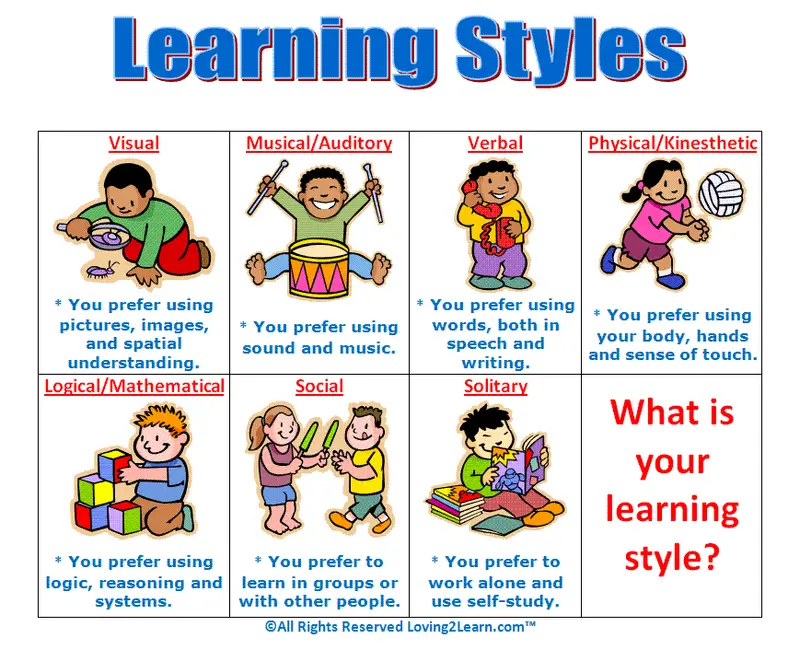
There are different ways that people learn best. I learn best by reading. I would be classified as a visual learner. Others learn best by listening. They are auditory learners and would do well with audiobooks or being read aloud to or even reading aloud to themselves. Others learn best by moving, touching and manipulating. They are considered kinesthetic learners or hands-on learners.
Study and learn your own kids.
Further reading on this subject:
The Way They Learn
Every Child Can Succeed: Making the Most of Your Child’s Learning Style
By Cynthia Ulrich Tobias
There are other ways to categorize cognitive styles or different ways of thinking and learning. We need to find the ways that work best for ourselves. And we also would do our children a great favor by helping them discover the style that helps them to learn more quickly, efficiently and thoroughly.
We also should observe and study the way in which we organize our learning in our brains and what is the most comfortable and conducive atmosphere for us to learn in.
Multiple Intelligences
Linguistic, Logical, Spatial, Musical, Kinesthetic, Interpersonal, Intrapersonal
These are 7 categories that have been identified by Dr. Howard Gardner, a professor of education at Harvard.
Dr. Kathy Koch writes and speaks about 8 great smarts. She writes about the multiple intelligences and tweaks them a little bit. She calls them: Word Smart, Logic Smart, Picture Smart, Music Smart, Body Smart, Nature Smart, People Smart and Self Smart.
She wrote a book called “8 Great Smarts” in which she explores the different ways that children can be smart. A summary of the topics covered in this book is here:
“Your child is smart, but does he or she believe it?
“Smart” is a power word. Children who believe they’re smart excel more in school and approach life with greater confidence. But children who don’t can struggle to apply themselves. Do you wish your child could see how smart he or she is?
Find hope in 8 Great Smarts. You’ll be empowered and equipped with new language and creative ideas for how to:
Accept and affirm your child’s unique smarts
Motivate your child to learn and study with all 8 smarts
Reawaken any “paralyzed” smarts
Redirect misbehavior in new, constructive ways
Guide your child spiritually, relationally, and to a good career fit
Dr. Kathy Koch loves seeing children flourish and helping parents make it happen–and it’s never too late to start. Now is the time to help your child be all that God designed him or her to be.”
Dr. Kathy has written other helpful books that offer parents tools to lead their children to become the best version of themselves and discover who God made them to be.
There’s another model that goes even further than the multiple intelligences in exploring what qualities several people who are considered geniuses had in common. This is a fascinating topic to think about as we are examining our children and learning how to keep the love of learning alive in our children. You can read about the 12 Genius Qualities HERE. I’ll give you a hint: They’re probably not what you think they are. Okay, I’ll tell you what the genius qualities are: curiosity, playfulness, imagination, creativity, wonder, wisdom, inventiveness, vitality, sensitivity, flexibility, humor, and joy.
____________________
New brain studies have revealed information about how our brains work that have fascinating implications for teaching and learning.
For more information about brain-based learning read books by Dr. Caroline Leaf:
and
_____________________
It can also be helpful to determine your personality type and the personality of each of your children.
If you understand yourself, you can modify the way you do things in a way that lowers stress and helps you to feel successful and avoids stressing yourself out.
And if you understand your child’s personality, you may learn how to say things in such a way or explain concepts in a way that makes sense to him/her. You may figure out how to avoid conflict and attain a better understanding of why your child says and does the things they say and do. At least, you may become more patient and gain some clues that will help you to have more peaceful interactions within your family if you understand what makes them tick. You may be very surprised to find out what some of them are thinking. Lots of times, they hear something completely different from what you were trying to say to them!
There are several different ways to find out what your personality type is.
One is the Myers-Briggs personality test. You can take the test for free at https://www.16personalities.com/free-personality-test
And some are specifically made for homeschool moms so that we can identify our strengths and weaknesses and we can become more comfortable in our own skin and not compare ourselves to other homeschool moms or try to imitate them when their ways will not work for us.
Myers Briggs for homeschool: https://www.simplyconvivial.com/2016/homeschool-personality
I personally found this helpful in understanding and accepting the differences in the way different people conduct their homeschools and feeling affirmed that what I was doing was okay and acceptable, because it lined up with the way God made me.
You may pinpoint your mothering personality here:
This is a good thing to know so that you can refrain from judging others because of lack of understanding. In Jill’s words:
“We desperately need to be true to ourselves, allow others to be different, and knock off the judgement that so easily creeps into our head and our heart!”
Another way of measuring personality types is the Personality Colors quiz from Full Spectrum Communication: https://jacobadamo.com/personality-colors-quiz/
To go a little deeper you may want to read the book “Strengths Finder 2.0” by Tom Rath. This could help you discover what you were made to do and help you fulfill your calling. This concept emphasizes finding out your strengths and capitalizing on them instead of working hard on areas that you are weak in, because you are not gifted and called to do these things. Chasing your weaknesses does not make sense.
Of course, you can look at it from the perspective that God may call you to do something that is difficult for you to do so that you have to lean on Him and go in His strength instead of your own. But in many cases, the Lord gifts you to do the thing that He has called you to do.
And you may discover hidden gifts as you grow and mature. It makes life very interesting, to say the least.
This may seem like it’s a tangent, but I really like tangents myself 🙂 so here goes! I think it’s also good to find out what your love language is and the love languages of the rest of your family. If you would like to find out more about what that’s all about, read “The Five Love Languages” by Dr. Gary Chapman. And then you may also want to read “The Five Love Languages of Children” and “The Five Love Languages of Teens“. You can find these and many other helpful resources HERE.
As you delve deeper into purpose, calling, destiny, and helping your children become all that God made them to be, you may want to check out Dr. Lance Wallnau’s teachings and resources at https://lancewallnau.com/category/motivational/











 "Oh that God would give every mother a vision of the glory and splendor of the work that is given to her when a babe is placed in her bosom to be nursed and trained! Could she have but one glimpse in to the future of that life as it reaches on into eternity; could she look into its soul to see its possibilities; could she be made to understand her own personal responsibility for the training of this child, for the development of its life, and for its destiny,--she would see that in all God's world there is no other work so noble and so worthy of her best powers, and she would commit to no other's hands the sacred and holy trust given to her." -JR Miller